May 28, 2026
When an owner starts shopping for property management, the first question is almost always the same: "What percentage do you charge?"
It's an understandable question. It's also the wrong place to start.
The real cost of property management is not the monthly percentage on your statement. It's the total amount of money, time, and opportunity that leaks out of your rental over twelve months. A 7% manager with a list of add-on fees, a high vacancy rate, weak tenant screening, and a generic approach to pricing can cost more in a single year than an 8% manager with a transparent fee structure and disciplined operations.
So instead of asking only, “What is your management fee?” owners should ask a better question:
“What will this management relationship cost or save me over the next year?”
That is where the real comparison begins.
This post is for owners who want to look past the headline percentage and understand what management actually costs over an entire year.
The Monthly Management Fee Is Only the Beginning
Most management companies in the Boise area charge somewhere between 8% and 12% of collected rent. On a $2,000/month rental, the difference between 8% and 10% is $40/month, or $480/year. That sounds meaningful — until you compare it against everything else that affects your bottom line.
The headline percentage is the most visible cost. It's also one of the smaller ones.
The fees you don't see on the homepage are usually where the real money goes. Before signing with any property manager, ask for an annual all-in cost estimate, not just a management percentage.
Common Property Management Fees Owners Should Look For
A typical management agreement may include some combination of these:
- Monthly management fee — usually a percentage of collected rent.
- Leasing fee — charged each time a new tenant is placed (often half to a full month of rent).
- Renewal fee — charged when an existing tenant signs another lease.
- Setup or onboarding fee — a one-time charge to take on the property.
- Inspection fee — for routine property check-ins.
- Maintenance coordination fee — for arranging repairs.
- Maintenance markup — a percentage added to vendor invoices.
- Vacancy or minimum monthly fee — charged even when the property isn't earning rent.
- Lease-up advertising fee — for marketing the listing.
- Eviction or notice coordination fee — for serving notices and managing legal action.
- Cancellation fee — for terminating the contract early.
A company advertising 7% may collect more from you in a year than a company advertising 8% — once leasing fees, renewal fees, and maintenance markups are added in. The advertised percentage is a marketing number. The annual all-in cost is the number that actually matters. None of these fees mentioned above are automatically wrong. A property management company is allowed to charge for its services. The issue is whether the pricing is clear, complete, and aligned with the owner’s best interest.
At Bluebird, our standard management fee is 8%, with reduced pricing available for larger portfolios, and we do not charge leasing fees, renewal fees, setup fees, vacancy minimums, or maintenance markups. That isn't because we think 8% is a magic number. It's because we believe the only fair way to compete is on transparency. Visit our Pricing Page for a real life example and to learn more!
The Cost of Vacancy
Vacancy is the single most expensive line item most owners never put on a spreadsheet.
On a $2,000/month rental, one extra vacant month costs $2,000. That's more than four years of difference between a 8% and 10% management fee on the same property. A manager who can fill a unit two weeks faster, or keep a quality tenant one year longer, has already paid for themselves several times over.
Reducing vacancy isn't about luck. It comes from accurate pricing, professional listing presentation, fast response to leads, flexible showing availability, smart renewal strategy, and steady tenant retention. If a manager can't explain how they handle each of those, they probably aren't reducing your vacancy. They're just collecting a fee while you absorb the cost.
The Cost of Underpricing or Overpricing Rent
Pricing a rental is one of the highest-leverage decisions a property manager makes — and one of the easiest to get wrong.
Underprice by $100/month, and you've quietly handed back $1,200 of annual income. Overprice by the same amount, and you may sit empty for an extra month or two while the market resets your expectations the hard way. Either mistake usually costs more than the management fee itself. Get in touch with us for a free Rental Market Analysis specific to your property!
The hard part is that pricing isn't just a number. It's a strategy. A property that should rent for $1,950 in March may need to be listed at $1,895 in November. Seasonality matters in the Treasure Valley rental market. A unit with covered parking and a fenced yard isn't a comp for a unit without them, even if they share a zip code. A property that's been freshly painted is not the same product as the one across the street that hasn't been updated since 2014.
Furthermore, good rental pricing is not about getting the highest number possible. It is about finding the rent that maximizes
annual performance after vacancy risk, tenant quality,
market conditions, and property-specific features are considered.
Read our blog post on Rental Pricing HERE!
Getting pricing right means looking at the actual property, the actual neighborhood, the actual competing listings sitting on the market right now, and the actual time of year. It can't be done in three seconds by software.
Which leads to the next problem.
The Cost of Poorly Implemented AI
AI is everywhere right now, and property management is no exception. Used well, it's a real advantage. Used poorly, it's an expensive shortcut.
The clearest example is automated rent estimates. Many management companies pull a number from a software tool that compares beds, baths, square footage, and rough location — and stop there. That tool doesn't see the layout or flow of the home. It doesn't know how well the kitchen update was executed, whether the yard is an awkward layout, what exact type of windows there are, whether the property backs up to a busy road, or whether the comp it used is actually in a street with a VERY different feel. It produces a confident-looking number from a surface-level comparison.
A rent estimate generated in seconds can cost an owner thousands if nobody stops to ask whether the comps actually make sense.
The same problem shows up in tenant communication. A bad chatbot or a generic automated response system can make residents feel ignored, which leads to lower retention, worse reviews, and more turnover — all of which are owner costs, even though they look like tenant problems. Read our blog post on the power of tenant rentention HERE!
Our position is straightforward: technology should support judgment, not replace it. We use data and software extensively. We also analyze the neighborhood, look at competing listings, evaluate the actual condition of the property, factor in nearby amenities, and consider owner goals before recommending a rent price. A rental analysis should be a considered opinion, not a guess dressed up as math.
The Cost of Bad Tenant Placement
The most expensive property management mistake is rarely on the invoice. It's the wrong tenant.
A poorly screened tenant can cost an owner unpaid rent, eviction expenses, property damage, neighbor complaints, weeks or months of legal process, and the recovery time of getting the property re-rented after they leave. The financial damage from a single bad placement often exceeds an entire year of management fees.
The temptation is always to fill the unit fast. The right approach is to fill the unit correctly. That means consistent screening on income, credit, rental history, references, prior evictions, and verifiable employment — applied the same way to every applicant, every time, in full compliance with fair housing law.
A property manager's screening process is one of the most important things to evaluate during the hiring conversation. If they can't explain it clearly, that's the answer. Read more about our screening process HERE!
The Cost of Poor Maintenance Decisions
Maintenance is where the gap between cheap and effective shows up most clearly.
The cheapest repair is not always the lowest invoice. The cheapest repair is the one that solves the problem correctly the first time, protects the property from further damage, keeps the tenant relationship intact, and doesn't need to be redone six months later.
A management company that picks vendors based purely on price may save $75 on a single invoice and spend $300 on a second visit when the first repair fails. A company that ignores small issues until they become large ones may save coordination time today and trade it for a capital expense next year. A company that marks up vendor invoices has a financial incentive that doesn't quite match the owner's.
Good maintenance is asset preservation. It's about catching the small things, choosing vendors who do the job right, and being honest with owners about what is and isn't worth doing.
The savings from cutting corners on maintenance tend to show up later, somewhere more expensive.
Read more about our Maintenance Services HERE!
The Cost of Tenant Frustration
Owners sometimes think tenant experience is separate from owner returns.
It is not.
Tenant experience directly affects vacancy, renewal rates, property condition, communication, and long-term performance. A tenant who feels ignored is less likely to renew. A tenant who cannot get maintenance handled may become frustrated. A tenant who receives unclear communication may lose trust. A tenant who feels nickel-and-dimed by unnecessary fees may begin looking for another place to live.
Turnover is expensive.
When a tenant moves out, the owner may face vacancy, cleaning, repairs, marketing, showings, leasing time, and uncertainty. Even a smooth turnover has a cost. A difficult turnover can cost much more.
This is why tenant retention matters. Read more about that HERE!
Keeping a good tenant is often better than constantly chasing the highest possible rent with no regard for the resident experience. Rent growth is important, but so is stability. A strong renewal strategy should consider market rent, tenant quality, property condition, and long-term owner goals.
Owners do not need a property manager who gives tenants everything they want.
They need a property manager who communicates clearly, enforces the lease, handles maintenance responsibly, and treats tenants respectfully.
A rental property performs better when both sides of the relationship are managed well.
The Cost of Your Own Time
Self-management is often framed as a way to save the management fee. For some owners, that math works. For most, the real cost is hidden somewhere else.
The most underappreciated cost of self-management isn't the time it takes to handle a maintenance call or screen an applicant. It's the cost of what you stopped doing to handle them.
Owners who self-manage often start there to save money on a single property. As the portfolio grows, the owner becomes the bottleneck. Instead of analyzing the next deal, talking to lenders, planning capital improvements, or looking at new markets, they're coordinating vendors, chasing late rent, fielding tenant questions, and managing renewals.
For owners who want to keep growing, self-management can become the handbrake that quietly limits the portfolio.
The right property manager should give you confidence that your properties are being operated the way you intended — and free you up to focus on acquisitions, strategy, and long-term growth. Our goal isn't to be one more thing on an owner's plate. It's to be the reason there's room on the plate for the next deal.
At some point, the question is no longer:
“Can I manage this myself?”
The better question is:
“Is managing this myself the best use of my time?”
The Cost of Misaligned Incentives
A property manager's pricing model says a lot about how the company makes money.
Some structures create incentives that don't match the owner's interests:
- A leasing fee can quietly reward turnover, because the manager gets paid more when tenants leave.
- A renewal fee can charge owners for the best outcome — keeping a good tenant in place.
- A maintenance markup can put the manager on the wrong side of every repair conversation.
- A vacancy fee or monthly minimum can charge owners during the months they're already losing money, while reducing managers incentive to fill the property.
- A long-term contract with high cancellation penalties can reduce accountability once the deal is signed.
None of these structures are illegal or unusual. They're common. But owners should understand what they incentivize before agreeing to them.
A property manager's pricing model should make money when the owner makes money, not when the owner has a problem. Read more about our fees HERE!
The Cost of Poor Reporting and Communication
A rental property is an investment. Owners should not feel like they are guessing how that investment is performing. Poor reporting can create hidden costs because it makes it harder for owners to make good decisions. If statements are confusing, maintenance records are unclear, rent collection updates are inconsistent, or owners cannot easily see what is happening, they may miss important trends. They may not realize expenses are increasing. They may not know whether rent is below market. They may not understand why maintenance costs are higher than expected. They may not have clean records for taxes, financing, or future sale decisions. Good communication does not mean overwhelming owners with every small detail. It means giving owners clear, useful information at the right time.
Owners should know:
- When rent is collected.
- When distributions are sent.
- What maintenance was completed.
- Why repairs were necessary.
- How the property is performing.
- Whether rent should be adjusted.
- Whether a tenant is renewing.
- Whether there are issues that need attention.
- What decisions require owner input.
A property manager should reduce uncertainty, not create it.
When communication is poor, owners often end up spending more time following up, asking questions, and trying to understand what is happening. That defeats one of the main reasons they hired a property manager in the first place.
How to Compare Property Management Companies Fairly
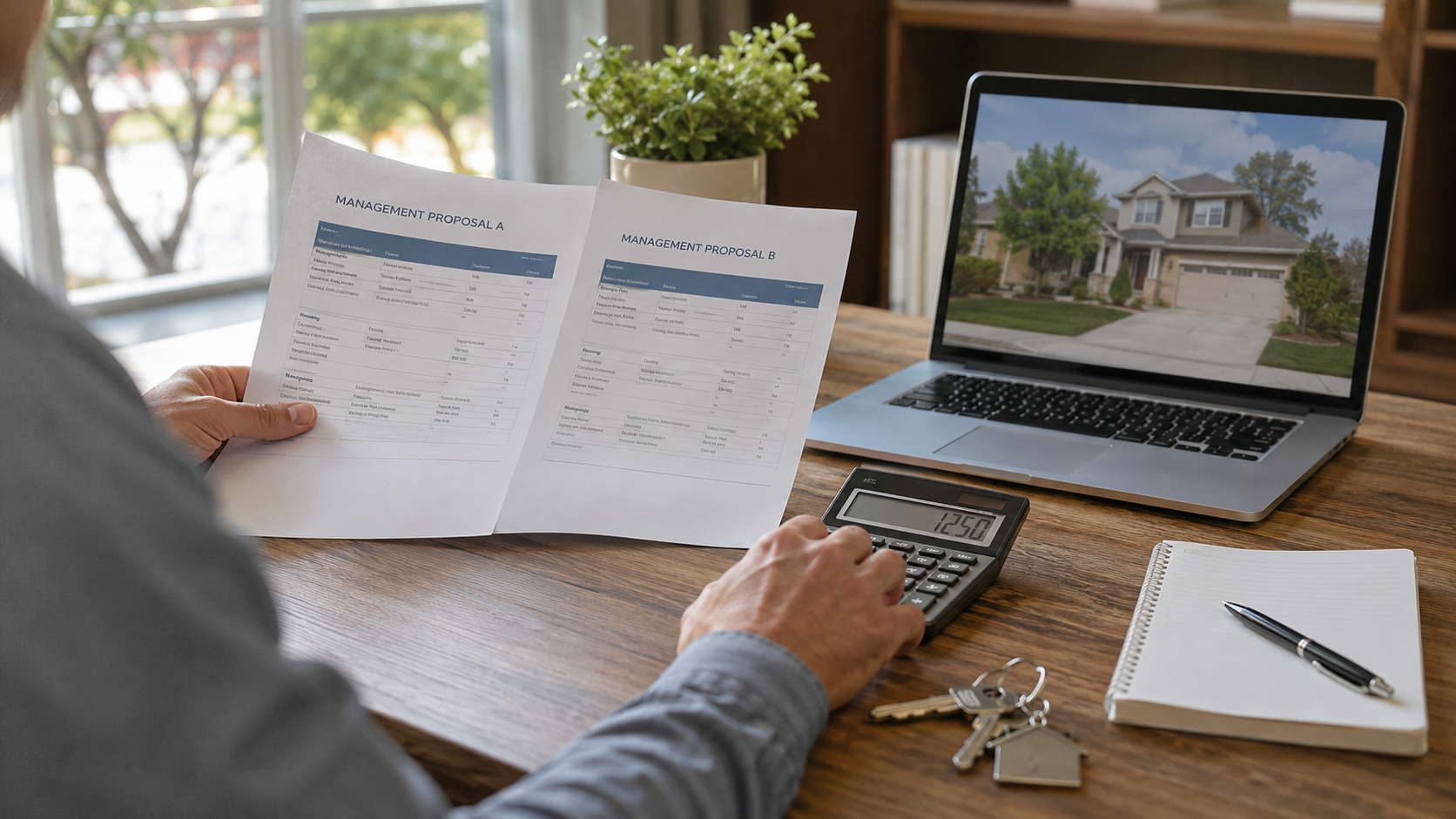
When you're comparing companies, the most useful comparison isn't the management percentage. It's the projected annual cost.
Before signing with any property manager, ask:
- What is the monthly management fee, and is it charged on rent collected or rent due?
- Is there a leasing fee? A renewal fee? A setup fee?
- Is there a vacancy fee or monthly minimum?
- Is there a maintenance markup, and how are vendors selected?
- Are routine inspections included?
- Are lease renewals included?
- Are there cancellation fees, and how does the contract end?
- What happens financially if the property sits vacant?
- How do you price rent? Is it an automated tool, or is someone reviewing the property and the local comps?
- How do you screen tenants, and what are your minimum criteria?
- How do you handle renewals and tenant retention?
- What reports will I receive?
- What does the maintenance process look like from request to resolution?
Then ask the most important question:
What will I pay over a typical twelve month period for this specific property?
A manager who can answer that clearly is showing you how they think. A manager who can't is asking you to trust the marketing.
Final Thought: The Real Question Is Not "What Do You Charge?"
The cheapest property manager is rarely the one with the lowest advertised percentage. The cost of vacancy, underpricing, bad tenants, poor maintenance, misaligned fees, and over-reliance on shortcuts almost always outweighs whatever you save on the headline number.
The better question isn't "What do you charge?"
It's "What will this management relationship cost or save me over the next year — and what could I be doing with my time if my properties were being managed properly?"
That's the question that separates an expense from an investment.
Want a clearer picture of what property management could cost for your rental property?
If you'd like a clear annual cost comparison for your property in Boise, Meridian, Eagle, or the surrounding Treasure Valley, we're happy to put one together. No hidden fees, no leasing fees, no renewal fees, no maintenance markups — just a straightforward look at what good management should actually cost. Get in touch with us HERE!